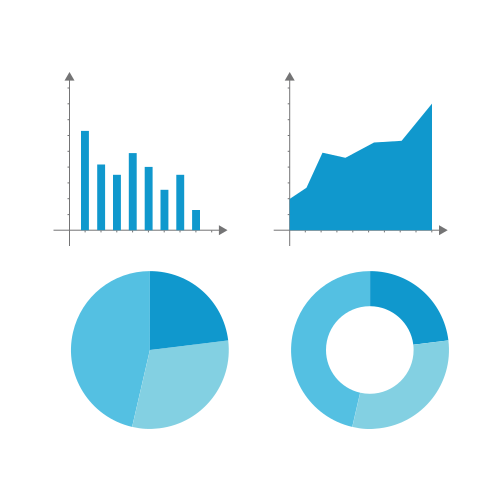
SVG paths are written as a single d attribute — a mini-language of commands and coordinates that describes shapes. Each command is a letter; uppercase means absolute coordinates, lowercase means relative to the current position. This is a reference for all path commands with examples, followed by a worked pie chart that puts the arc command through its paces.
A Kickstarter project finally arrived, it's a book called A New Reality: Human Values and World Population. It is a republication of a book originally by Jonas Salk. His son Jonathan Salk created this project to release an updated edition. It talks about modern-day issues primarily caused by over population creating this 'new reality'.
It's premise revolves around the sigmoid curve and how human population growth is out the point of inflection (the middle point of the curve where it transistions). All living organisms population growth follow this sigmoid curve. It can be seen with bacteria in petri dishes, fruit flies in glass containers and sheep introduced on the secluded Tasmania island. Even outside of laboratories at some point limits (food sources or waste removal) are reached causing populations to eventually plateau. Analysing human population growth we have been experiencing a period massive accaleration; And appear to be in the phase on inflection. Through this the book offers hope and warnings for the future. Many indicators suggest we have reached the turning point in human population growth (primarily that our population growth has actually started to decalerate).
A reference for chart types, anatomy, and terminology — particularly useful when working with D3 or communicating design intent to engineers and stakeholders.
Terminology
Graph — a diagram representing a mathematical function or relationship between variables, typically drawn as a continuous line. The term comes from graph theory; in common usage it is often conflated with "chart" but strictly refers to a plotted function.
Chart — a graphical representation of data using shapes, symbols, or spatial encoding (bars, slices, bubbles). Charts communicate patterns in discrete or categorical data rather than continuous functions.
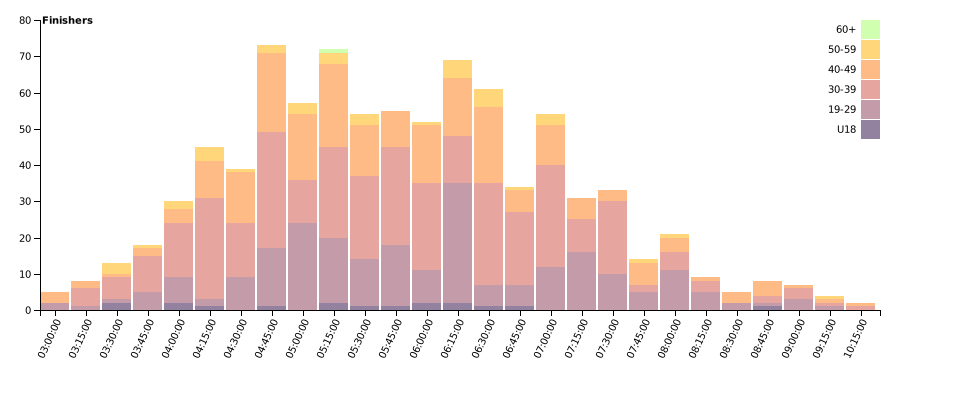
We had an awesome weekend away in Bright, a small mountain town on the edge of Victoria Australia. Completing the Spartan race trifecta. The trifecta is where one completes all three of the Spartan race types (Sprint - 7km+, Super - 14km+ and Beast - 21km+). The sprint turned out to be around 9.5km and the beast was 24km which was a little more than we were expecting.
Some enthusiasts will attempt whats called an Ultra Beast where you run the Beast course twice. Effectively giving you a full marathon experience whilst completing obstacles and mountain climbs. Three crazy monkeys were attempting it on the Sunday. Two completed and one was disqualified for surpassing the time limit. I'm blown away and impressed by these individuals.
A corpus linguistics analysis of the original Italian text of the Divina Commedia — measuring vocabulary coverage thresholds and frequency distribution to quantify the reading challenge it presents to a learner of Italian.
Background
Dante Alighieri (1265–1321) was a Florentine poet whose Divina Commedia — written between approximately 1308 and 1320, the year before his death — is considered a cornerstone of world literature and a foundational text of the Italian language. The work comprises three canticles: Inferno, Purgatorio, and Paradiso, tracing an allegorical journey through the afterlife guided by the Roman poet Virgil.
A frequency analysis of Harry Potter und der Stein der Weisen using Python and NLTK, exploring what corpus linguistics reveals about the vocabulary threshold for reading comprehension in a second language.
Methodology
The source text was processed using NLTK (Natural Language Toolkit) in Python. The pipeline: tokenize the raw text with nltk.word_tokenize, lowercase and strip punctuation, then build a frequency distribution with nltk.FreqDist. Stopwords were deliberately not removed — function words like articles, pronouns, and conjunctions are exactly what a language learner needs to acquire, and stripping them would distort the comprehension model.